Description
Complement C3: The Most Important Protein in the Complement System
- Gene Information: The human C3 gene is located on chromosome 19p13.3. It encodes complement component 3, the central effector protein of the complement cascade, belonging to the α2-macroglobulin superfamily of thioester-containing proteins.
- Protein Expression: C3 is predominantly synthesized and secreted by hepatocytes in the liver into peripheral blood. Smaller amounts are locally produced by renal tubular epithelial cells, macrophages and endothelial cells.
- Signaling Pathway: C3 serves as the universal convergence point for the classical, lectin and alternative complement pathways. All three cascades assemble C3 convertase to cleave intact C3 into two bioactive fragments: anaphylatoxin C3a and opsonin C3b. C3b further participates in C5 convertase formation to initiate terminal complement activation and MAC assembly, driving inflammatory response and tissue injury.
- Therapeutic Inhibition: These therapeutic candidates represent diverse strategies: small peptide inhibitors block the enzymatic cleavage of C3; siRNA molecules silence C3 expression; and antibodies directly neutralize C3 function. Their development underscores a multifaceted approach to curb pathological complement activation.
Complement factor B: A serine protease that is a central component of the alternative complement pathway.
- Gene Information: CFB gene encodes complement factor B (CFB), a 93 kDa serine protease zymogen belonging to the trypsin-like serine protease family. CFB is an essential component of the alternative complement pathway, where it participates in the formation and stabilization of the C3 convertase complex.
- Protein Expression: CFB is primarily synthesized and secreted by hepatocytes in the liver and circulates in plasma as an inactive precursor.
- Signaling Pathway: Upon activation of the alternative complement pathway, complement factor B binds to C3b and is subsequently cleaved by complement factor D into two fragments: the non-catalytic fragment Ba and the catalytic serine protease subunit Bb, forming the active alternative pathway C3 convertase (C3bBb).
- Therapeutic Inhibition: CFB inhibition represents a promising therapeutic strategy for complement-mediated diseases by selectively suppressing alternative pathway activation. Potential applications include autoimmune diseases (lupus and rheumatoid arthritis), ophthalmic disorders such as age-related macular degeneration (AMD), and renal diseases including atypical hemolytic uremic syndrome (aHUS) and C3 glomerulopathy (C3G), where uncontrolled complement activation drives inflammation, tissue injury, and organ dysfunction.
Targeting strategy
C3*R102G
- The genome sequence of human C3 gene with R102G mutation encodes the whole molecule (ATG to STOP codon), including 5’UTR and 3’UTR, were inserted into the Hipp11 (H11) locus .
- The human C3 expression is driven by the human C3 promoter.
- R102G was an SNP named C3F. The C3F variant is associated with several diseases, including IgA nephropathy, C3G, and age-related macular degeneration.
CFB
- The exons 1~18 of the mouse Cfb gene that encoded the full-length protein were replaced by human CFB exons 1~18 in B-hCFB plus/hC3*R102G mice.
- The promoter, 5’UTR and 3’UTR region of the mouse gene are replaced by human counterparts.
- The human CFB expression is driven by human CFB promoter, while mouse Cfb gene transcription and translation will be disrupted.
Note: B-hCFB plus/hC3*R102G mice were obtained by mating B-hC3*R102G mice (113286) and B-hCFB mice plus (113153). Mouse C3 gene was not knockout.
C3 Protein Expression Analysis
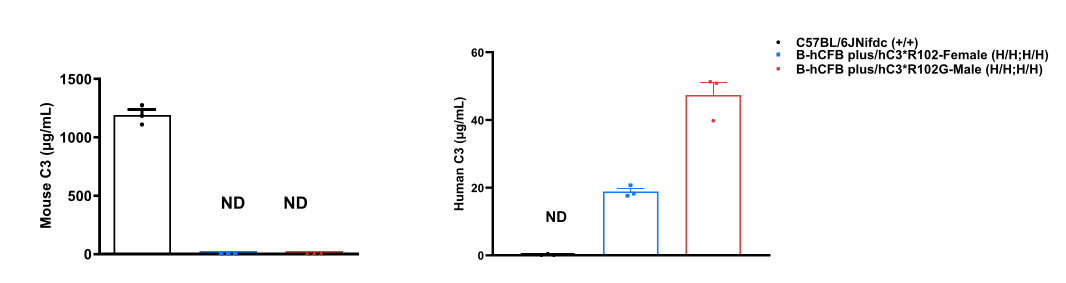
Strain specific C3 expression analysis in wild-type C57BL/6JNifdc mice and homozygous humanized B-hCFB plus/hC3*R102G mice by ELISA. Serum was collected from wild-type C57BL/6JNifdc mice (+/+) (male, n=3, 9-week-old) and homozygous B-hCFB plus/hC3*R102G mice (H/H; H/H) (female and male, n=3, 9-week-old). Expression level of mouse C3 and human C3 were analyzed by ELISA (mouse C3 ELISA kit: Abcam, ab157711; human C3 ELISA kit: Abcam, ab108823). Mouse C3 was only detectable in wild-type C57BL/6JNifdc mice. Human C3 was exclusively detectable in homozygous B-hCFB plus/hC3*R102G mice. Values are expressed as mean ± SEM.
CFB Protein Expression Analysis
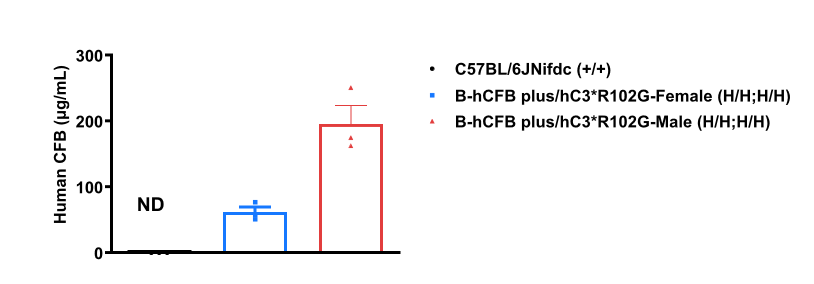
Strain specific CFB expression analysis in wild-type C57BL/6JNifdc mice and homozygous humanized B-hCFB plus/hC3*R102G mice by ELISA. Serum was collected from wild-type C57BL/6JNifdc mice (+/+) (male, n=3, 9-week-old) and homozygous B-hCFB plus/hC3*R102G mice (H/H; H/H) (female and male, n=3, 9-week-old). Expression level of human CFB were analyzed by ELISA (human CFB ELISA kit: Abcam, ab137973). Human CFB was exclusively detectable in homozygous B-hCFB plus/hC3*R102G mice. Values are expressed as mean ± SEM.
* When publishing results obtained using this animal model, please acknowledge the source as follows: The animal model [B-hCFB plus/hC3*R102G mice] (Cat# 114282) was purchased from Biocytogen.