
C57BL/6JNifdc-Mrgprb2tm2( (MRGPRX2)Bcgen/Bcgen • 113996

Key Advantages
Validation
Application

In B-hMRGPRX2 mice plus, the coding region and 3' UTR of the mouse Mrgprb2 gene encoding the extracellular domain, transmembrane domain, and cytoplasmic region were replaced by corresponding human MRGPRX2 sequences.
This targeting strategy enables human MRGPRX2 expression from the endogenous mouse Mrgprb2 locus in a C57BL/6JNifdc background. B-hMRGPRX2 mice plus provide an in vivo platform for evaluating MRGPRX2 antagonists and mast cell-mediated pseudo-allergic reactions.

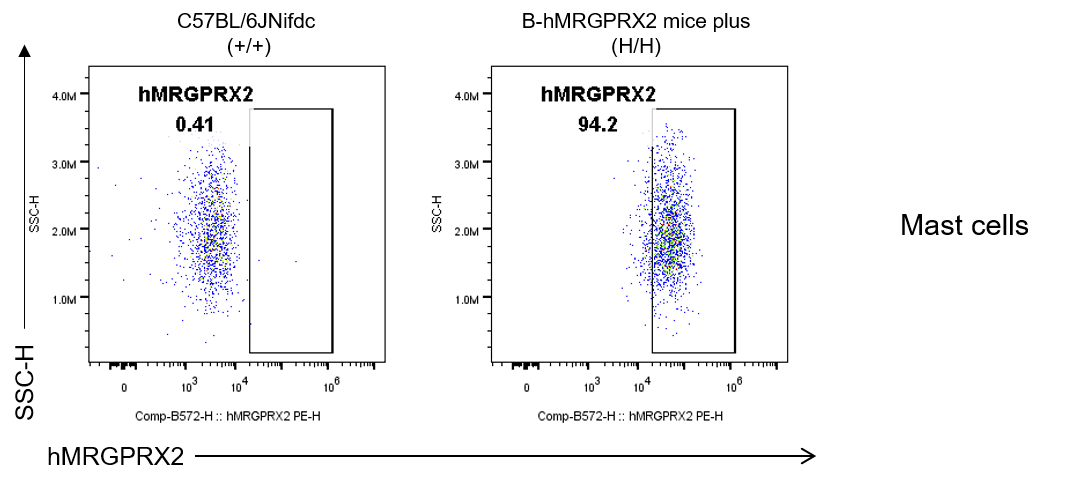
MRGPRX2 expression analysis in homozygous MRGPRX2 humanized mice by flow cytometry. Peritoneal lavage fluid cells were collected from wild-type C57BL/6JNifdc mice (+/+) and homozygous B-hMRGPRX2 mice plus (H/H), and analyzed by flow cytometry with anti-human MRGPRX2 antibody (BioLegend, 359004). hMRGPRX2 was detectable in peritoneal lavage fluid mast cells in homozygous B-hMRGPRX2 mice plus, but not in wild-type mice.
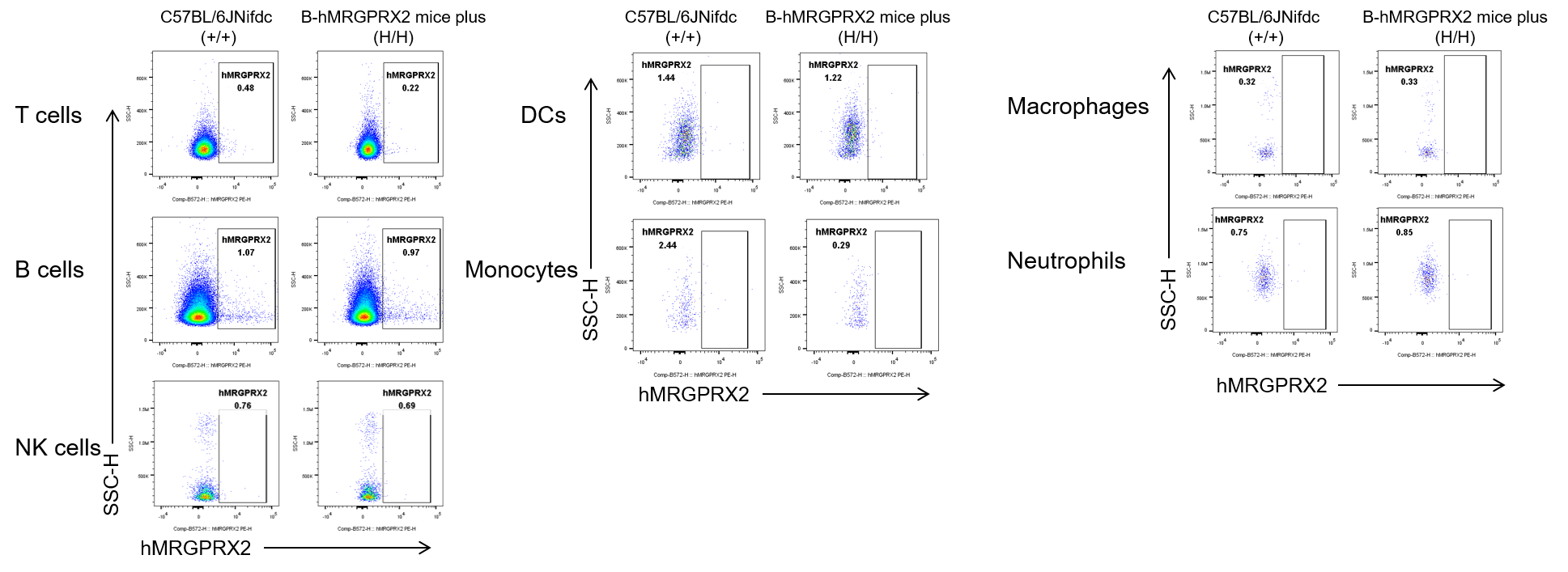
MRGPRX2 expression analysis in homozygous MRGPRX2 humanized mice by flow cytometry.
Splenocytes were collected from wild-type C57BL/6JNifdc mice (+/+) and homozygous B-hMRGPRX2 mice plus (H/H), and analyzed by flow cytometry with anti-human MRGPRX2 antibody (BioLegend, 359004). Human MRGPRX2 was not detectable on T cells, B cells, NK cells, DCs, monocytes, macrophages, and neutrophils of spleen in C57BL/6JNifdc mice and homozygous B-hMRGPRX2 mice plus.
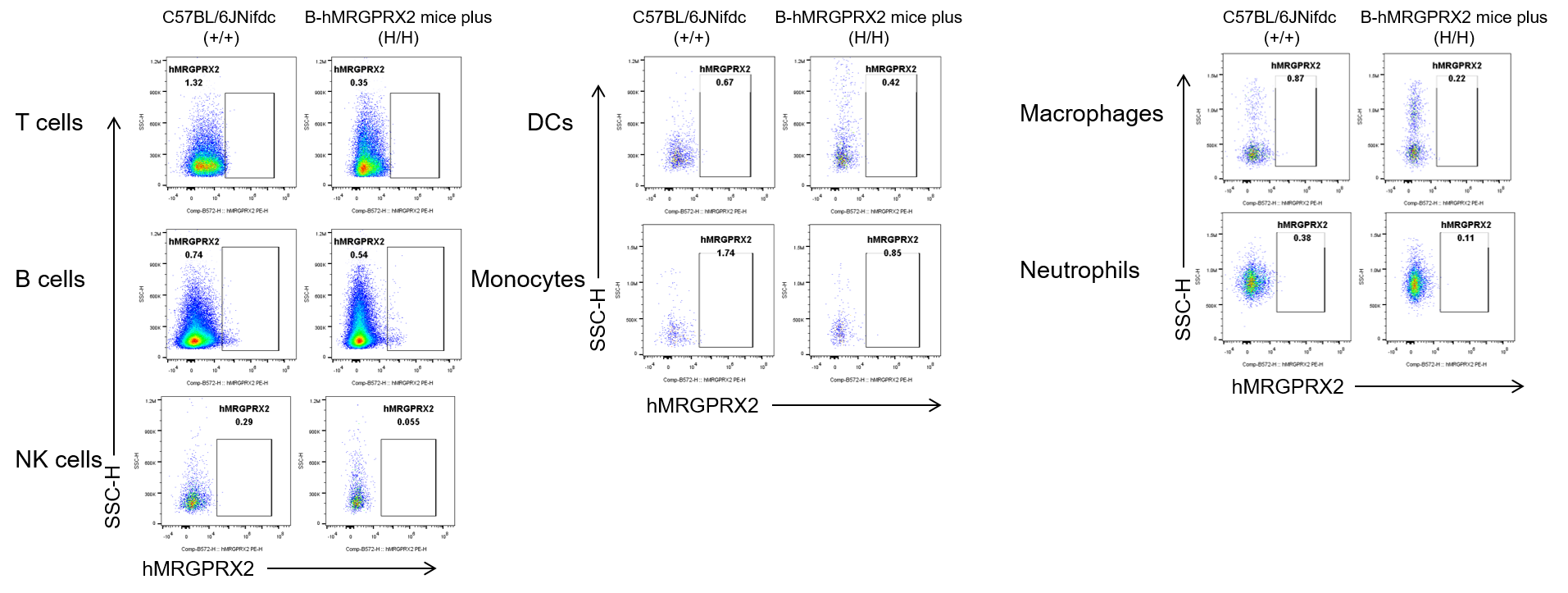
Human MRGPRX2 expression analysis in homozygous MRGPRX2 humanized mice by flow cytometry.
Blood cells were collected from wild-type C57BL/6JNifdc mice (+/+) and homozygous B-hMRGPRX2 mice plus (H/H), and analyzed by flow cytometry with anti-human MRGPRX2 antibody (BioLegend, 359004). Human MRGPRX2 was not detectable on T cells, B cells, NK cells, DCs, monocytes, macrophages, and neutrophils of blood in C57BL/6JNifdc mice and homozygous B-hMRGPRX2 mice plus.

Effects of MRGPRX2 antagonist-1 on Cortistatin-14 induced systemic anaphylaxis-like reaction in MRGPRX2 humanized mice.
B-hMRGPRX2 mice plus (H/H) were challenged with Cortistatin-14 on day 0. MrgprX2 antagonist-1 (5 mpk, commercially purchased) was injected 4 h before challenge on day 0. Body temperature was recorded from 0 to 90 minutes after the challenge of 1 mg/kg Cortistatin-14. MrgprX2 antagonist-1 produced an increasing trend in the Cortistatin-14 induced systemic anaphylaxis-like reaction model and showed an inhibitory effect on the decrease in body temperature in B-hMRGPRX2 mice plus.

Q1: What are B-hMRGPRX2 mice plus?
B-hMRGPRX2 mice plus are gene-humanized mice in which the mouse Mrgprb2 coding region and 3’ UTR were replaced by the corresponding human MRGPRX2 sequences.
Q2: Why is MRGPRX2 important?
MRGPRX2 is a mast cell receptor involved in sensing secretagogues that trigger mast cell degranulation, pseudo-allergic reactions, itch, pain, and inflammation.
Q3: How was human MRGPRX2 expression validated?
Human MRGPRX2 protein expression was validated by flow cytometry in peritoneal lavage fluid mast cells from homozygous B-hMRGPRX2 mice plus.
Q4: Can B-hMRGPRX2 mice plus be used for antagonist studies?
Yes. MRGPRX2 antagonist-1 showed an inhibitory effect on body temperature decrease in the Cortistatin-14 induced systemic anaphylaxis-like reaction model.
Q5: What are the main applications of B-hMRGPRX2 mice plus?
Applications include MRGPRX2 antagonist evaluation, mast cell degranulation studies, pseudo-allergy research, itch and inflammation studies, and GPCR-targeted drug development.