Description
- Background: TMIGD2, initially described as Immunoglobulin-containing Proline-rich Receptor-1 (IGPR-1) and CD28 Homolog (CD28H), is a membrane glycoprotein belonging to the immunoglobulin superfamily (IgSF). It has been identified as the receptor for HHLA2 (also known as B7y/B7H7/B7-H5/B7-H7), which is widely expressed in tumors with varying prognostic implications. The HHLA2/CD28H interaction activates human T cells through the AKT pathway, inducing production of cytokines including IFN-γ, TNF-α, IL-5, and IL-10. Furthermore, HHLA2 synergizes with CD28H to trigger NK cell degranulation and generation of cytokines such as IFN-γ, TNF-α, and MIP-1α.
- Targeting strategy: The full coding sequences of human TMIGD2 gene, including the promoter, 5’UTR and 3’UTR are inserted into mouse Hipp11 (H11) locus in B-hTMIGD2 mice.
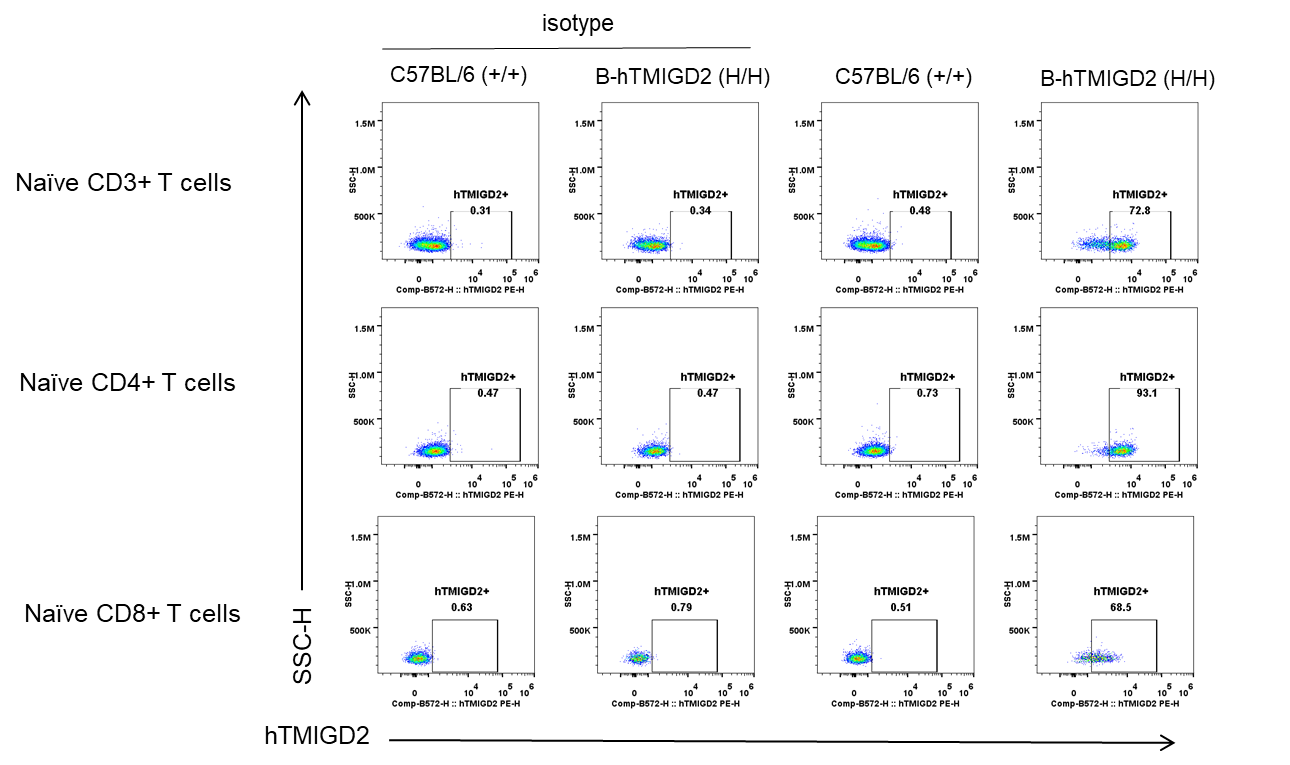
- Validation: Human TMIGD2 was detectable on Naïve T cells in homozygous B-hTMIGD2 mice.
- Application: This humanized mouse model can be utilized for safety assessment of anti-TMIGD2 antibodies; while the HHLA2/TMIGD2 double-gene humanized mouse serves for efficacy evaluation.
Targeting Strategy
Gene targeting strategy for B-hTMIGD2 mice. The full coding sequences of human TMIGD2 gene, including the promoter, 5’UTR and 3’UTR are inserted into mouse Hipp11 (H11) locus in B-hTMIGD2 mice.
Protein expression analysis in spleen
Strain specific TMIGD2 expression analysis with splenocytes from homozygous B-hTMIGD2 mice by flow cytometry. Splenocytes were collected from wild-type C57BL/6 mice (+/+) and homozygous B-hTMIGD2 mice (H/H), analyzed by flow cytometry with species-specific anti-human TMIGD2 antibody (R&D, FAB83162P-100). Human TMIGD2 was exclusively detectable on Naïve T cells in homozygous B-hTMIGD2 mice.
* When publishing results obtained using this animal model, please acknowledge the source as follows: The animal model [B-hTMIGD2 mice] (Cat# 112969) was purchased from Biocytogen.