SHANK3 MOA: SHANK3 Plays Important Roles in the Formation, Maturation, and Maintenance of Synapses
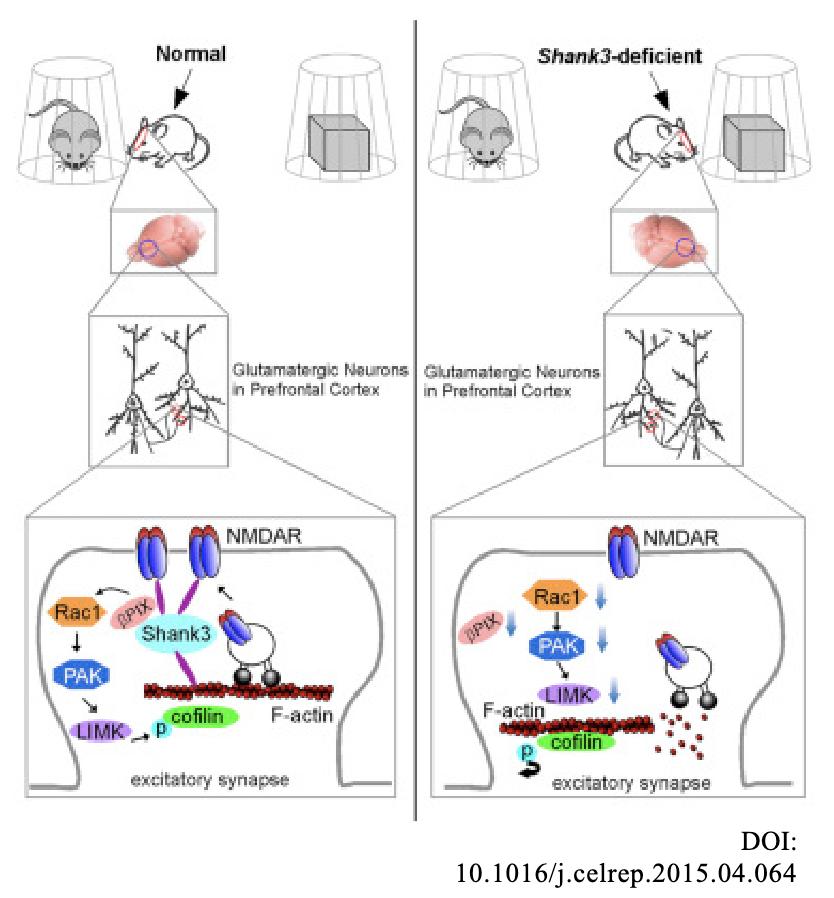
SHANK3: The most prominent risk gene for autism spectrum disorder.
- Gene Information: SHANK3, located on human chromosome 22q13, encodes a key postsynaptic scaffold protein. Mutations or deletions of this gene are tightly associated with autism spectrum disorder (ASD) and Phelan–McDermid syndrome (PMS).
- Protein Expression: SHANK3 is a synaptic scaffolding protein enriched in the postsynaptic density of excitatory synapses, and plays important roles in the formation, maturation, and maintenance of synapses. It is abundantly expressed in the cerebral cortex, striatum, hippocampus, thalamus, amygdala and cerebellum within the central nervous system.
- Signaling Pathway: Mutations in SHANK3 lead to autism and intellectual disability, possibly by altering the phase-separation properties of SHANK3, which impairs CaMKII recruitment, modulates synaptic strength and mediates dynamic remodeling of the postsynaptic density (PSD).
- Therapeutic Replacement: AAV-based gene therapy targeting SHANK3 for ASD delivers functional copies of the Shank3 gene into brain cells to supply adequate SHANK3 protein levels, which durably restores synaptic function required for learning and memory.
B-Shank3 KO Mice: Gene Targeting Strategy
Shank3
- The exons 4-22 of mouse Shank3 gene were deleted in B-Shank3 KO mice.
B-Shank3 KO Mice: mRNA Expression Analysis
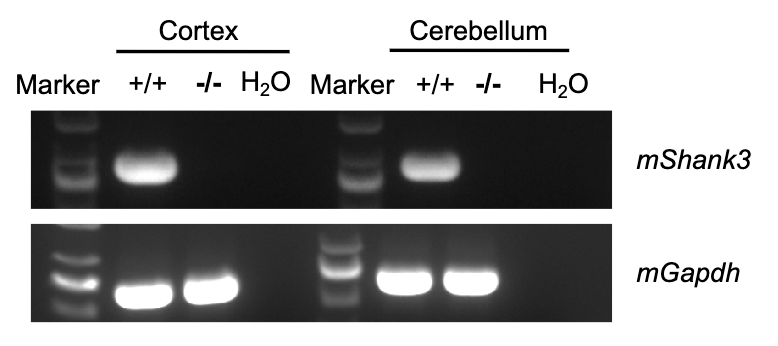
- Mouse Shank3 was detected in wild-type mice, but not in homozygous B-Shank3 KO mice.
Strain-specific Shank3 expression analysis in wild-type C57BL/6 mice and homozygous B-Shank3 KO mice.
Cortex and cerebellum RNA were isolated from wild-type C57BL/6 mice (+/+) and homozygous B-Shank3 KO mice (-/-), then cDNA libraries were synthesized by reverse transcription, followed by PCR with mouse Shank3 primers.
B-Shank3 KO Mice: Protein Expression Analysis
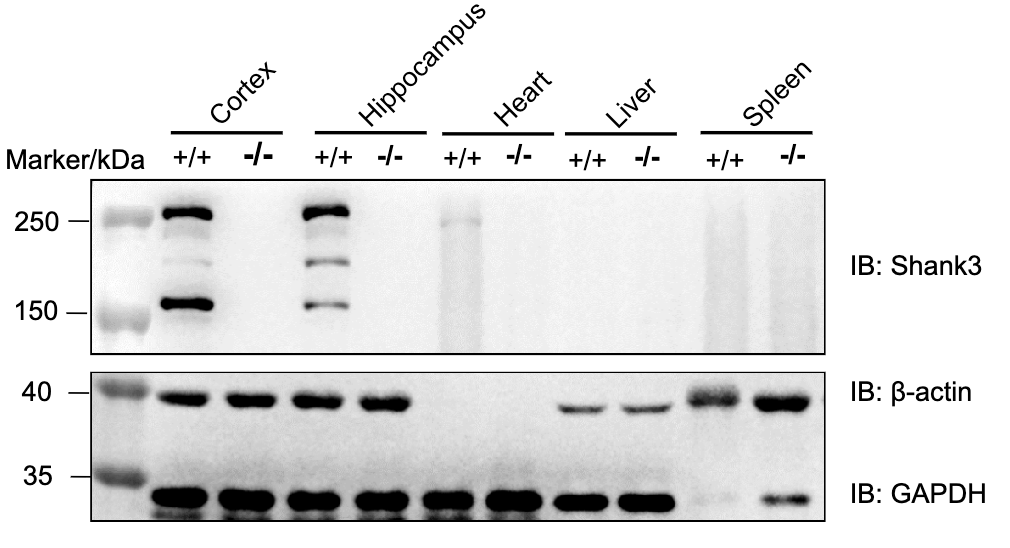
- SHANK3 was detected in wild-type mice, but not in homozygous B-Shank3 KO mice.
Western blot analysis of SHANK3 protein expression in homozygous B-Shank3 KO mice. Various tissue lysates were collected from wild-type C57BL/6 mice (+/+) and homozygous B-Shank3 KO mice (-/-), and then analyzed by western blot with anti-Shank3 antibody (CST, 64555). 40 μg total proteins were loaded for western blotting analysis.
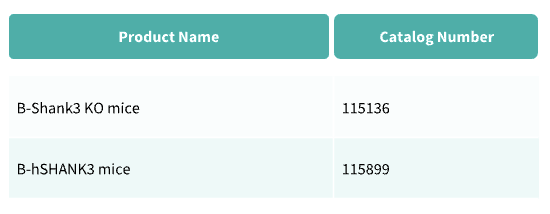
B-Shank3 KO Mice: Related Product List
* When publishing results obtained using this animal model, please acknowledge the source as follows: The animal model [B-Shank3 KO mice] (Cat# 115136) was purchased from Biocytogen.