Background:
Numerous clinical studies have found increased levels of IL-23 in various autoimmune diseases, including psoriasis, inflammatory bowel disease (IBD), rheumatoid arthritis (RA), and multiple sclerosis (MS). Targeted therapy against IL-23 has made significant progress in the field of autoimmune diseases, becoming a research hotspot and a key therapeutic target. However, new research indicates that the role of IL-23 is not limited to autoimmune diseases; its potential in tumor immunotherapy is equally noteworthy. Preclinical studies have shown that IL-23 exhibits tumor-promoting properties in various cancer models and is associated with poor patient prognosis. Therefore, ablation of IL-23 or its receptors could reduce tumor burden. Most currently developed drugs targeting human IL23R do not recognize mouse IL23R, therefore mouse models cannot be used for preclinical efficacy or safety evaluations.
Methods:
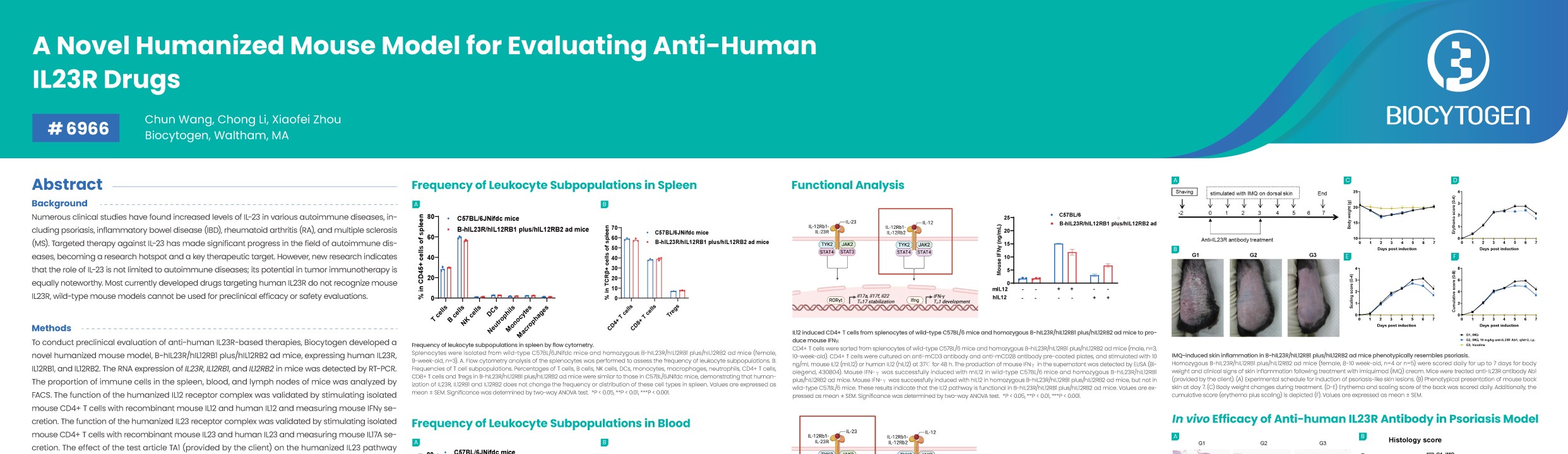
To conduct preclinical evaluation of anti-human IL23R-based therapies, Biocytogen developed a novel humanized mouse model, B-hIL23R/hIL12RB1 plus/hIL12RB2 ad mice, expressing human IL23R, IL12 receptor β1, and IL12 receptor β2. The function of the humanized IL12 receptor complex was validated by stimulating isolated mouse CD4+ T cells with recombinant mouse IL12 and human IL12 and measuring mouse IFN-γ secretion. The function of the humanized IL23 receptor complex was validated by stimulating isolated mouse CD4+ T cells with recombinant mouse IL23 and human IL23 and measuring mouse IL17A secretion. The effect of the test article TA1 (provided by the client) on the humanized IL23 pathway was validated in vitro.
Results:
In vitro stimulation with mouse IL12 and human IL12 induced the secretion of mIFN-γ by CD4+ T cells of C57BL/6 mice, while human IL12 induced the secretion of mIFN-γ by CD4+ T cells of B-hIL23R/hIL12RB1 plus/hIL12RB2 ad mice, confirming the function of the humanized IL12 receptor complex. In vitro stimulation with mouse IL23 and human IL23 induced the secretion of mIL17A by CD4+ T cells of C57BL/6 mice and B-hIL23R/hIL12RB1 plus/hIL12RB2 ad mice, confirming the function of the humanized IL23 receptor complex. In vitro use of the test article TA1 (provided by the client) significantly inhibited the secretion of mouse IL17A in the humanized IL23 pathway of B-hIL23R/hIL12RB1 plus/hIL12RB2 ad mice.
Conclusion
The humanized IL12 receptor complex and humanized IL23 receptor complex in B-hIL23R/hIL12RB1 plus/hIL12RB2 ad mice are functional and provide a valuable preclinical evaluation mouse model for assessing therapies targeting human IL23 and human IL12 receptors.