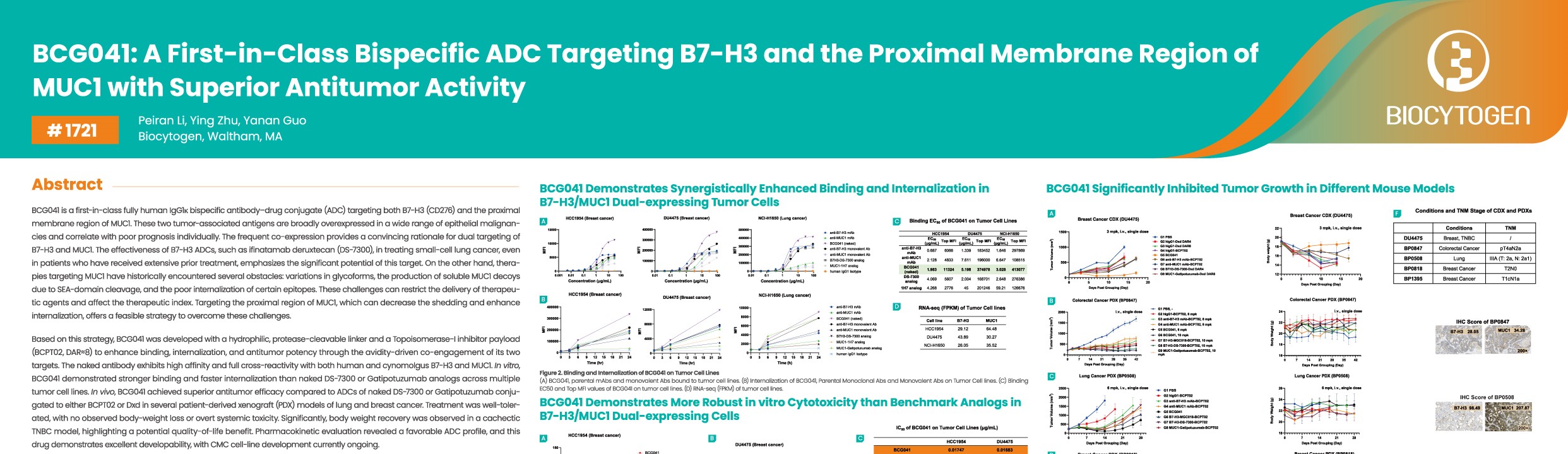
BCG041 is a first-in-class fully human IgG1κ bispecific antibody–drug conjugate (ADC) targeting both B7-H3 (CD276) and the proximal membrane region of MUC1. These two tumor-associated antigens are broadly overexpressed in a wide range of epithelial malignancies and correlate with poor prognosis individually. The frequent co-expression provides a convincing rationale for dual targeting of B7-H3 and MUC1. The effectiveness of B7-H3 ADCs, such as ifinatamab deruxtecan (DS-7300), in treating small-cell lung cancer, even in patients who have received extensive prior treatment, emphasizes the significant potential of this target. On the other hand, therapies targeting MUC1 have historically encountered several obstacles: variations in glycoforms, the production of soluble MUC1 decoys due to SEA-domain cleavage, and the poor internalization of certain epitopes. These challenges can restrict the delivery of therapeutic agents and affect the therapeutic index. Targeting the proximal region of MUC1, which can decrease the shedding and enhance internalization, offers a feasible strategy to overcome these challenges.
Based on this strategy, BCG041 was developed with a hydrophilic, protease-cleavable linker and a Topoisomerase-I inhibitor payload (BCPT02, DAR≈8) to enhance binding, internalization, and antitumor potency through the avidity-driven co-engagement of its two targets. The naked antibody exhibits high affinity and full cross-reactivity with both human and cynomolgus B7-H3 and MUC1. In vitro, BCG041 demonstrated stronger binding and faster internalization than naked DS-7300 or Gatipotuzumab analogs across multiple tumor cell lines. In vivo, BCG041 achieved superior antitumor efficacy compared to ADCs of naked DS-7300 or Gatipotuzumab conjugated to either BCPT02 or DXd in several patient-derived xenograft (PDX) models of lung and breast cancer. Treatment was well-tolerated, with no observed body-weight loss or overt systemic toxicity. Pharmacokinetic evaluation revealed a favorable ADC profile, and this drug demonstrates excellent developability, with CMC cell-line development currently ongoing.
Together, these data position BCG041 as a highly promising next-generation bispecific ADC for B7-H3/MUC1-positive malignancies, addressing significant unmet clinical needs in breast, lung, gastro-esophageal, head-and-neck, colorectal, prostate, and ovarian cancers.