
Background
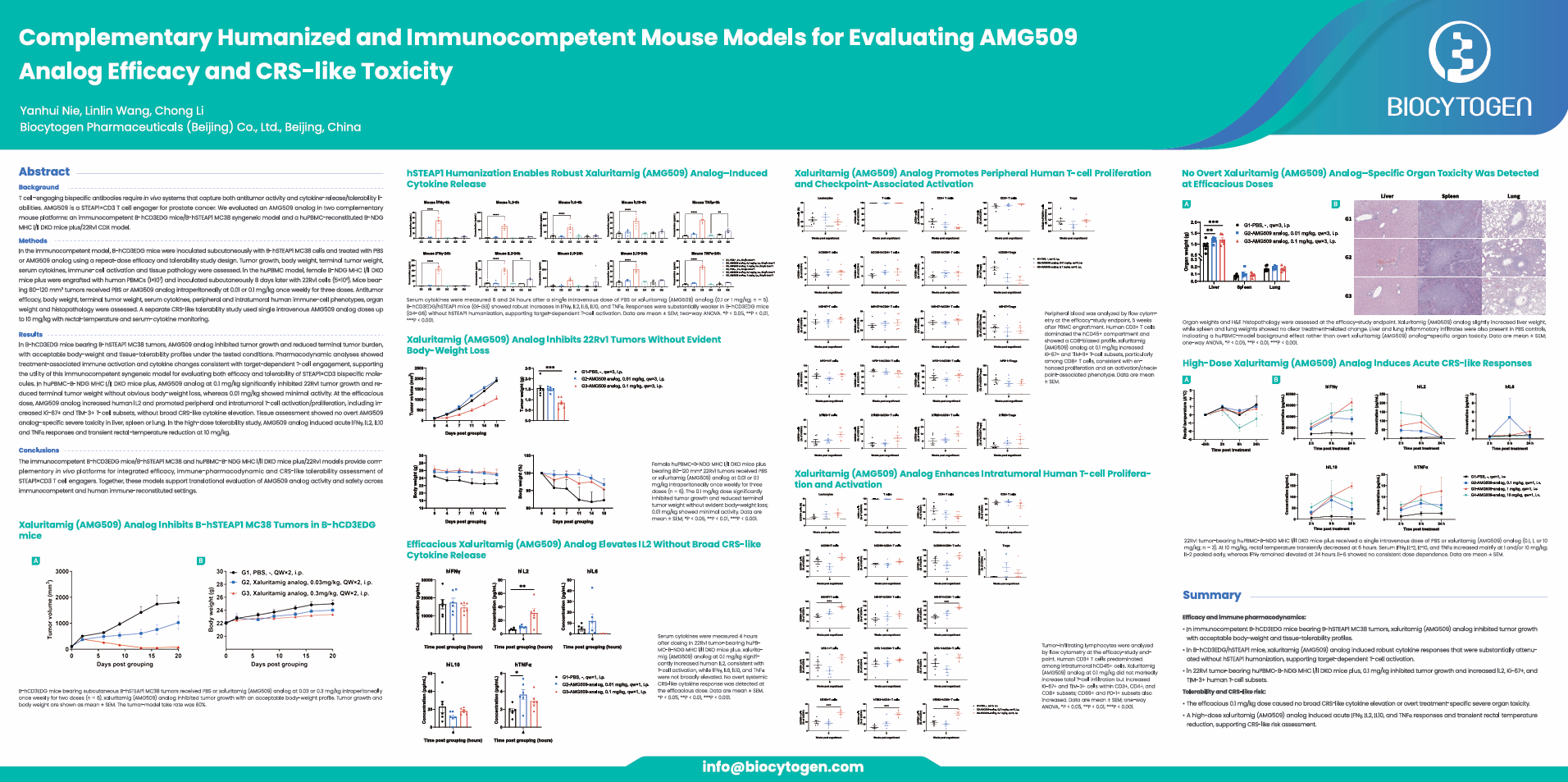
T cell—engaging bispecific antibodies require in vivo systems that capture both antitumor activity and cytokine-release/tolerability liabilities. AMG509 is a STEAP1xCD3 T cell engager for prostate cancer. We evaluated an AMG509 analog in two complementary mouse platforms: an immunocompetent B-hCD3EDG mice/B-hSTEAP1 MC38 syngeneic model and a huPBMC-reconstituted B-NDG MHC I/II DKO mice plus/22Rv1 CDX model.
Methods
In the immunocompetent model, B-hCD3EDG mice were inoculated subcutaneously with B-hSTEAP1 MC38 cells and treated with PBS or AMG509 analog using a repeat-dose efficacy and tolerability study design. Tumor growth, body weight, terminal tumor weight, serum cytokines, immune-cell activation and tissue pathology were assessed. In the huPBMC model, female B-NDG MHC 1/11 DKO mice plus were engrafted with human PBMCs (1x10⁷) and inoculated subcutaneously 8 days later with 22Rv1 cells (5x10⁶). Mice bearing 80—120 mm3 tumors received PBS or AMG509 analog intraperitoneally at 0.01 or 0.1 mg/kg once weekly for three doses. Antitumor efficacy, body weight, terminal tumor weight, serum cytokines, peripheral and intratumoral human immune-cell phenotypes, organ weight and histopathology were assessed. A separate CRS-like tolerability study used single intravenous AMG509 analog doses up to 10 mg/kg with rectal-temperature and serum-cytokine monitoring.
Results
In B-hCD3EDG mice bearing B-hSTEAP1 MC38 tumors, AMG509 analog inhibited tumor growth and reduced terminal tumor burden, with acceptable body-weight and tissue-tolerability profiles under the tested conditions. Pharmacodynamic analyses showed treatment-associated immune activation and cytokine changes consistent with target-dependent T-cell engagement, supporting the utility of this immunocompetent syngeneic model for evaluating both efficacy and tolerability of STEAP1xCD3 bispecific molecules. In huPBMC-B-NDG MHC I/II DKO mice plus, AMG509 analog at 0.1 mg/kg significantly inhibited 22Rv1 tumor growth and reduced terminal tumor weight without obvious body-weight loss, whereas 0.01 mg/kg showed minimal activity. At the efficacious dose, AMG509 analog increased human IL2 and promoted peripheral and intratumoral T-cell activation/proliferation, including increased Ki-67+ and TIM-3+ T-cell subsets, without broad CRS-like cytokine elevation. Tissue assessment showed no overt AMG509 analog—specific severe toxicity in liver, spleen or lung. In the high-dose tolerability study, AMG509 analog induced acute IFNу, IL2, IL10 and TNFα responses and transient rectal-temperature reduction at 10 mg/kg.
Conclusions
The immunocompetent B-hCD3EDG mice/B-hSTEAP1 MC38 and huPBMC-B-NDG MHC I/II DKO mice plus/22Rv1 models provide complementary in vivo platforms for integrated efficacy, immune-pharmacodynamic and CRS-like tolerability assessment of STEAP1xCD3 T cell engagers. Together, these models support translational evaluation of AMG509 analog activity and safety across immunocompetent and human immune-reconstituted settings.