
Background
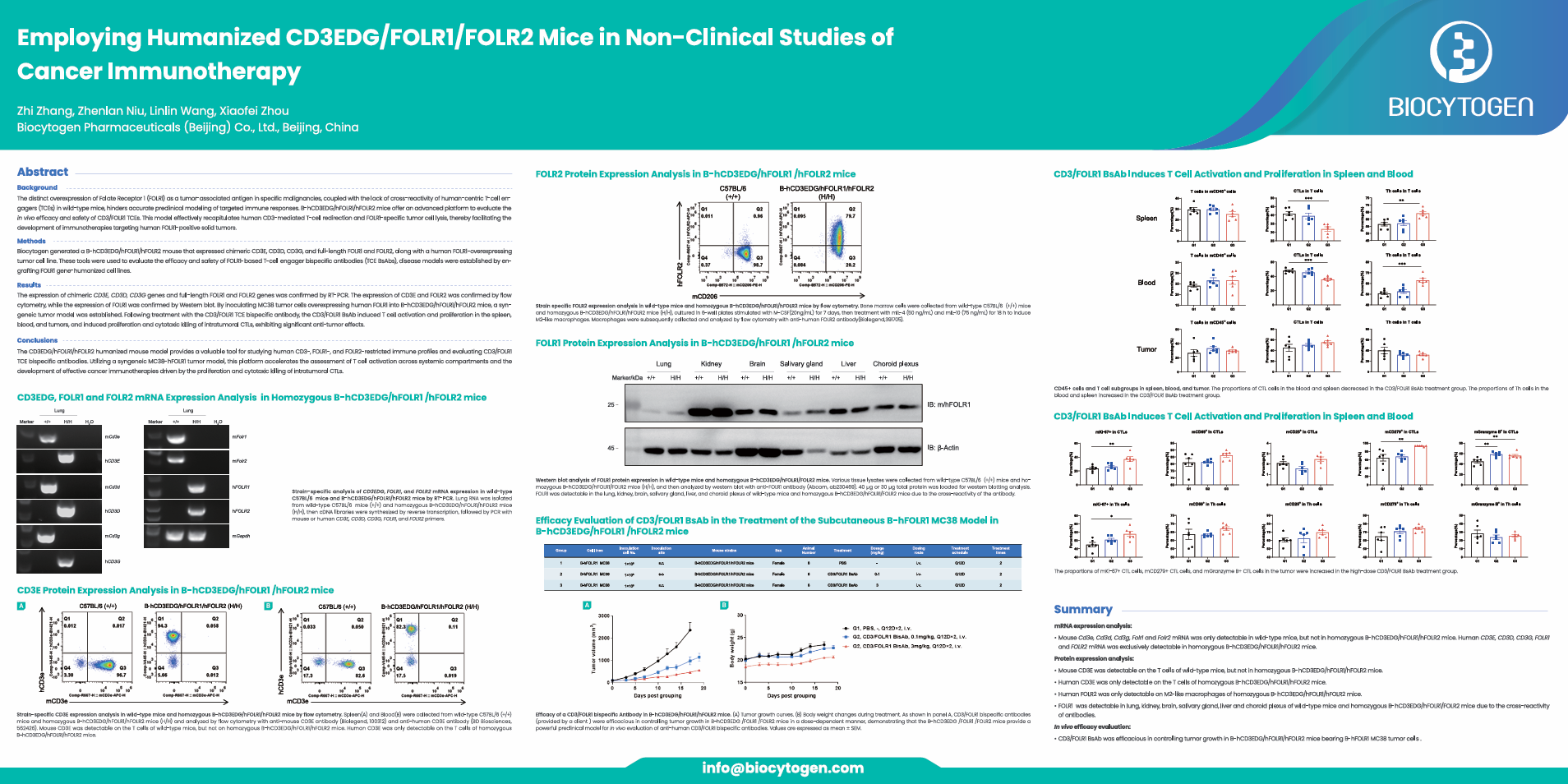
The distinct overexpression of Folate Receptor 1 (FOLR1) as a tumor-associated antigen in specific malignancies, coupled with the lack of cross-reactivity of human-centric T-cell engagers (TCEs) in wild-type mice, hinders accurate preclinical modeling of targeted immune responses. B-hCD3EDG/hFOLR1/hFOLR2 mice offer an advanced platform to evaluate the in vivo efficacy and safety of CD3/FOLR1 TCEs. This model effectively recapitulates human CD3-mediated T-cell redirection and FOLR1-specific tumor cell lysis, thereby facilitating the development of immunotherapies targeting human FOLR1-positive solid tumors.
Methods
Biocytogen generated a B-hCD3EDG/hFOLR1/hFOLR2 mouse that expressed chimeric CD3E, CD3D, CD3G, and full-length FOLR1 and FOLR2, along with a human FOLR1-overexpressing tumor cell line. These tools were used to evaluate the efficacy and safety of FOLR1-based T-cell engager bispecific antibodies (TCE BsAbs), disease models were established by engrafting FOLR1 gene-humanized cell lines.
Results
The expression of chimeric CD3E, CD3D, CD3G genes and full-length FOLR1 and FOLR2 genes was confirmed by RT-PCR. The expression of CD3E and FOLR2 was confirmed by flow cytometry, while the expression of FOLR1 was confirmed by Western blot. By inoculating MC38 tumor cells overexpressing human FOLR1 into B-hCD3EDG/hFOLR1/hFOLR2 mice, a syngeneic tumor model was established. Following treatment with the CD3/FOLR1 TCE bispecific antibody, the CD3/FOLR1 BsAb induced T cell activation and proliferation in the spleen, blood, and tumors, and induced proliferation and cytotoxic killing of intratumoral CTLs, exhibiting significant anti-tumor effects.
Conclusions
The CD3EDG/hFOLR1/hFOLR2 humanized mouse model provides a valuable tool for studying human CD3-, FOLR1-, and FOLR2-restricted immune profiles and evaluating CD3/FOLR1 TCE bispecific antibodies. Utilizing a syngeneic MC38-hFOLR1 tumor model, this platform accelerates the assessment of T cell activation across systemic compartments and the development of effective cancer immunotherapies driven by the proliferation and cytotoxic killing of intratumoral CTLs.