C57BL/6JNifdc-Pahtm1(PAH*R408W)Bcgen/Bcgen • 113493

PAH: Mutations in this gene lead to phenylketonuria (PKU).

PAH

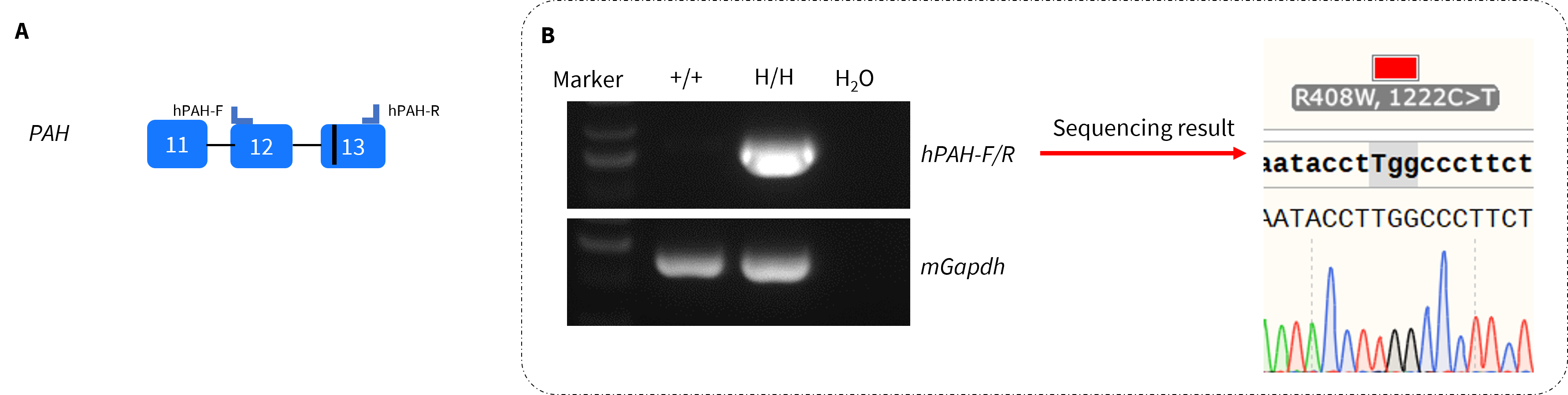
Strain specific analysis of PAH mRNA expression in wild-type C57BL/6JNifdc mice and B-hPAH*R408W mice by RT-PCR. Liver RNA were isolated from wild-type C57BL/6JNifdc mice (+/+) and homozygous B-hPAH*R408W mice (H/H), then cDNA libraries were synthesized by reverse transcription, followed by PCR with mouse or human PAH primers. (A) Primers were designed to detect the human exon 12 and mouse exon 13. (B) Human PAH mRNA was exclusively detectable in homozygous B-hPAH*R408W mice. The point mutation in homozygous B-hPAH*R408W mice was confirmed via Sanger sequencing.
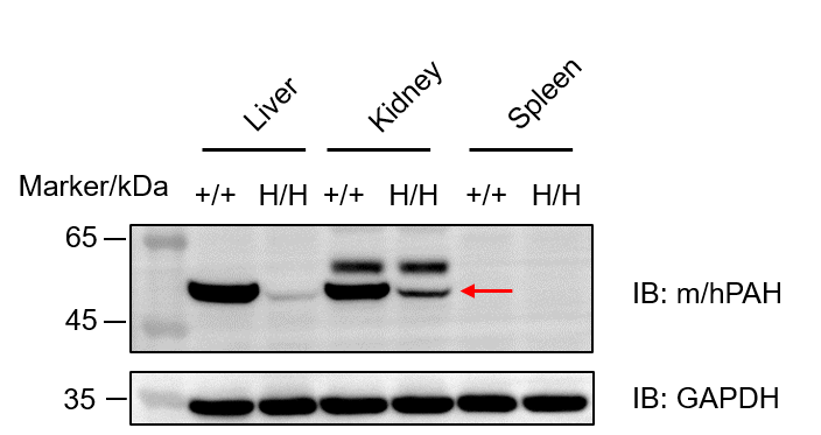
Western blot analysis of PAH protein expression in wild-type C57BL/6JNifdc and homozygous B-hPAH*R408W mice. Various tissue lysates were collected from wild-type C57BL/6JNifdc mice (+/+) and homozygous B-hPAH*R408W mice (H/H), and then analyzed by western blot with anti-PAH antibody (abcam, ab178430). 40 μg total proteins were loaded for western blot analysis. PAH protein expression was detected in the liver and kidney from both wild-type mice and homozygous B-hPAH*R408W mice (indicated by the red arrow), as the antibody used showed cross-reactivity between human and mouse PAH. Moreover, PAH protein expression level in both liver and kidney from wild-type mice were higher than those from homozygous mice.
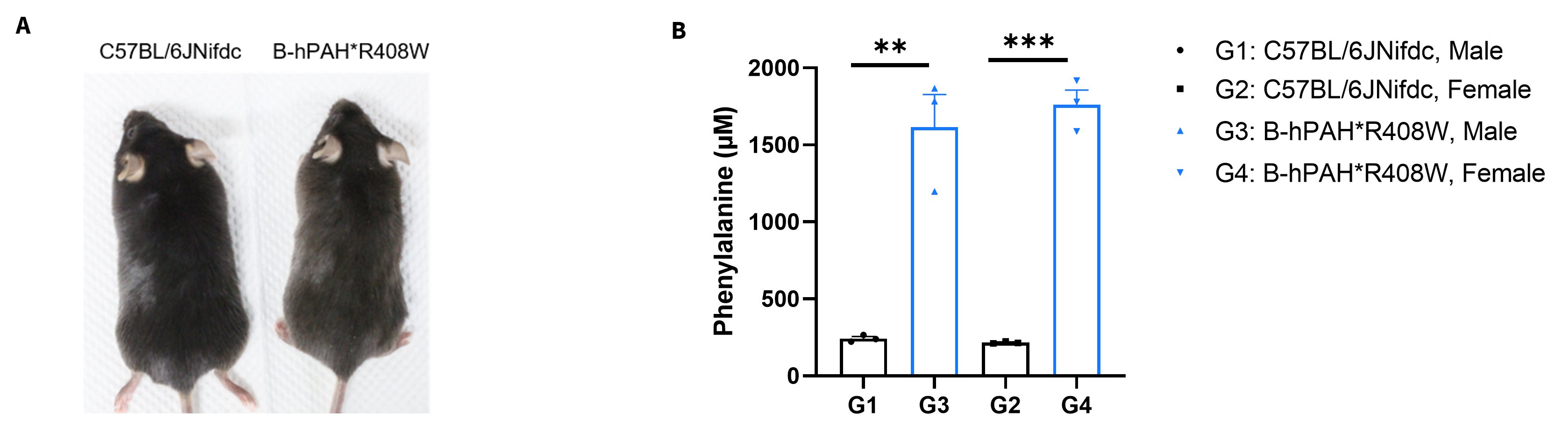
Hair coat color and phenylalanine concentration analysis in homozygous B-hPAH*R408W mice. (A) When compared to wild-type C57BL/6JNifdc mice (+/+, male, 12-week-old), homozygous B-hPAH*R408W mice (H/H, male, 12-week-old) exhibit gray fur. (B) Serum sample were collected from wild-type C57BL/6JNifdc mice (+/+, n=3 per sex, 8-week-old) and homozygous B-hPAH*R408W mice (H/H, n=3 per sex, 8-week-old). All of the mice were maintained on standard mouse chow. Serum phenylalanine (Phe) concentration was measured using phenylalanine assay kit (abcam, ab241000). The serum Phe concentration in homozygous B-hPAH*R408W mice (~1700 μM) was significant higher than those in wild-type mice. Values are expressed as mean ± SEM. Significance was determined by unpaired t test. *P < 0.05, **P < 0.01, ***P < 0.001.