Description
CDH17: A key adhesion molecule in tumor malignancy and its therapeutic intervention
- Gene Information: CDH17 is a member of the cadherin superfamily, encoding a calcium‑dependent membrane‑associated glycoprotein. The protein has a cadherin‑like structure: it possesses an extracellular region with seven cadherin domains and a transmembrane segment, but it lacks the conserved cytoplasmic domain.
- Protein Expression: In normal tissue, CDH17 restricted expression epithelium of small intestine and colon. CDH17 was overexpressed in colorectal adenocarcinoma, gastric adenocarcinoma and pancreatic adenocarcinoma. It can also be detected in liver metastases originated from colorectal adenocarcinoma.
- Signaling Pathway: It drives cancer progression—specifically cell adhesion, proliferation, migration, and invasion—by activating the Wnt/β-catenin, Ras/Raf/MEK/ERK, and α2/β1 integrin pathways (via its RGD motif), making its knockdown a promising therapeutic strategy to inhibit tumor malignancy.
- Therapeutic Inhibition: By blocking CDH17‑mediated adhesion and signaling, a CDH17‑targeted agent inhibits tumor progression and improves clinical outcomes, including reduced tumour growth, decreased metastasis, and prolonged survival.
Gene Targeting Strategy
CDH17
- The extracellular region (except signal peptide) of mouse Cdh17 was replaced by human CDH17 extracellular region sequences in B-hCDH17 mice.
mRNA Expression Analysis
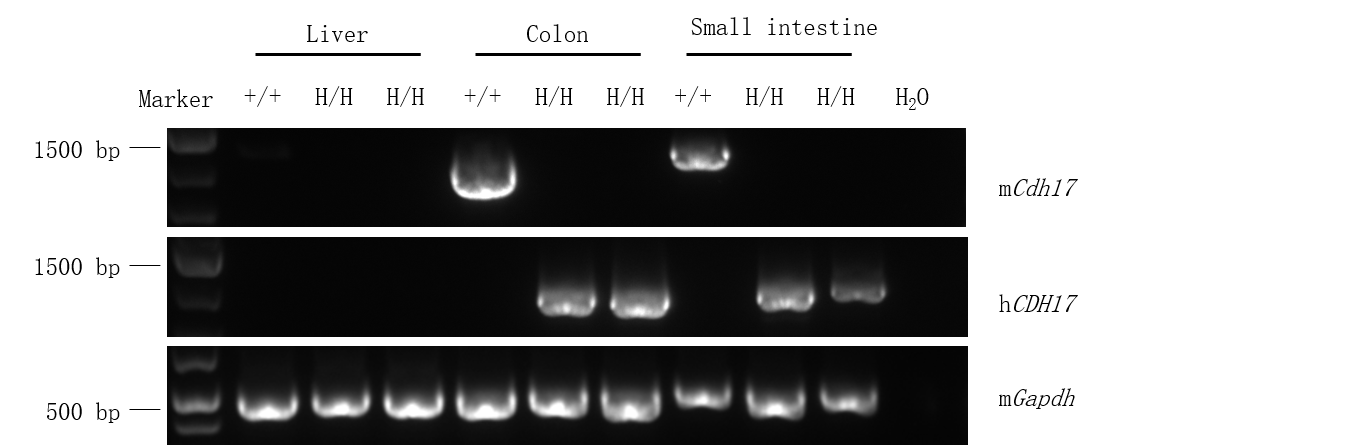
- Mouse Cdh17 mRNA was detectable in the colon and small intestine of wild-type mice, but not in the liver.
- Human CDH17 mRNA was exclusively detectable in the colon and small intestine of homozygous B-hCDH17 mice , but not in the liver.
Strain specific analysis of CDH17 mRNA expression in wild-type C57BL/6 mice and B-hCDH17 mice by RT-PCR. Liver, colon and small intestine RNA were isolated from wild-type C57BL/6 mice (+/+) and homozygous B-hCDH17 mice (H/H), and then cDNA libraries were synthesized by reverse transcription, followed by PCR with mouse or human CDH17 primers.
Protein Expression Analysis
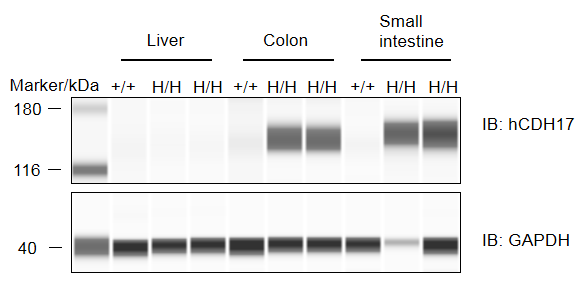
- Human CDH17 protein was detected in the colon and small intestine of homozygous B-hCDH17 mice, whereas human CDH17 protein was not detected in the liver of homozygous B-hCDH17 mice.
Simple Western analysis of CDH17 protein expression in homozygous B-hCDH17 mice. Liver, colon and small intestine lysates were collected from wild-type C57BL/6 (+/+) mice and homozygous B-hCDH17 mice (H/H), and then analyzed by Simple Western with species-specific anti-hCDH17 antibody (abcam, ab109190). 3ug total proteins were loaded for simple western analysis.
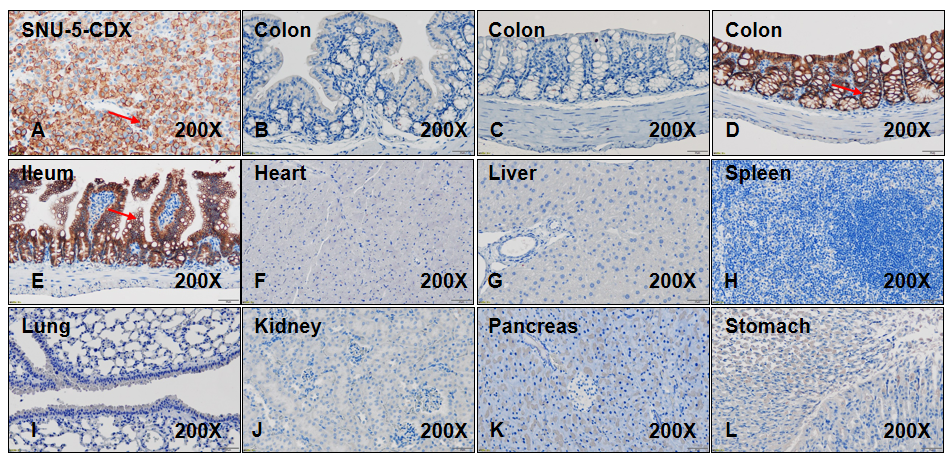
- Human CDH17 protein was detected in colon and ileum of homozygous B-hCDH17 mice, but not in heart, liver, spleen, lung, kidney, pancreas and stomach.
Representative human CDH17 expression in different tissues of B-hCDH17 mice by IHC. Tissues were stained with antibodies specific for human CDH17 (A-B, D-L) or anti-IgG antibody (C). Colon and ileum of B-hCDH17 mice show human CDH17 positive. Heart, liver, spleen, lung, kidney, stomach, and pancreas of B-hCDH17 mice show human CDH17 negative. Human gastric carcinoma cell line SNU-5 as a positive control (A); Colon tissues from the wild-type C57BL/6 mice as a negative control (B); Other tissues were got from homozygous B-hCDH17 mice (C-L). Original magnification ×200. Abbreviations: IHC, immunohistochemistry. The antibodies were provided by the client.
* When publishing results obtained using this animal model, please acknowledge the source as follows: The animal model [B-hCDH17 mice] (Cat# 111593) was purchased from Biocytogen.