

B-hTL1A/hTNFA/hTNFR1/hTNFR2 mice
C57BL/6-Tnfsf15tm2(TNFSF15)Bcgen Tnftm1(TNF)Bcgen Tnfrsf1atm1(TNFRSF1A)Bcgen Tnfrsf1btm1(TNFRSF1B)Bcgen /Bcgen • 113030

B-hTL1A/hTNFA/hTNFR1/hTNFR2 mice

Catalog Number
113030
Strain Name
C57BL/6-Tnfsf15tm2(TNFSF15)Bcgen Tnftm1(TNF)Bcgen Tnfrsf1atm1(TNFRSF1A)Bcgen Tnfrsf1btm1(TNFRSF1B)Bcgen /Bcgen
Strain Background
C57BL/6
NCBI gene ID
Aliases
TL1, TL1A, TNLG1B, VEGI, VEGI192A; DIF, IMD127, TNF-alpha, TNFA, TNFSF2, TNLG1F; CD120a, FPF, TBP1, TNF-R, TNF-R-I, TNF-R55, TNFAR, TNFR1, TNFR55, TNFR60, p55, p55-R, p60; CD120b, TBPII, TNF-R-II, TNF-R75, TNFBR, TNFR1B, TNFR2, TNFR80, p75, p75TNFR

このページで

  • Description
  • Phenotypic analysis

ポスター

すべて表示

    出版物

      Description

      TL1A: A key inflammation cytokine in chronic intestinal inflammation and fibrosis-related diseases.

      • Gene Information: TNF Superfamily Member 15 (TNFSF15, also known as TL1A) is a protein-coding gene located on chromosome 9q32. This cytokine is a ligand for receptor TNFRSF25 (also known as DR3) and TNFRSF6B (also known as DcR3). 
      • Protein Expression: TL1A is expressed in various immune cells (such as monocytes, macrophages, dendritic cells, and T cells) as well as in non-immune cells (such as synovial fibroblasts and endothelial cells). TL1A is a type II transmembrane protein that exists in either membrane-bound (mTL1A) or soluble (sTL1A) forms. 
      • Signaling Pathway: TL1A competes with Death Receptor 3 (DR3) for binding, providing stimulus signals for downstream signaling pathways, thereby regulating the proliferation, activation, apoptosis of effector cells, and the production of cytokines and chemokines. 
      • Therapeutic Inhibition: Blocking the interaction between TL1A and DR3 can reduce the severity of autoimmune diseases, such as the IBD model.

      TNFA: A master pathway of regulating inflammation, immune responses, and cell survival. 

      • Gene Information: Tumor necrosis factor (TNF) is a protein-coding gene located on chromosome 6p21.33. It encodes a multifunctional proinflammatory cytokine that belongs to the tumor necrosis factor (TNF) superfamily. TNF receptor superfamily member 1A (TNFRSF1A, TNFR1) encodes a member of the TNF receptor superfamily of proteins located on chromosome 12p13.31. TNF receptor superfamily member 1B (TNFRSF1B, TNFR2) encodes a member of the TNF receptor superfamily of proteins located on chromosome 1p36.22. 
      • Protein Expression: TNF is primarily expressed by macrophages. TNF is synthesized as a membrane-bound precursor and cleaved into a soluble circulating protein. TNFR1 is expressed on almost all nucleated cells. TNFR2 is expressed on CD4⁺ T cells, CD8⁺ T cells, Tregs, endothelial cells, microglia, specific neuronal subpopulations, oligodendrocytes, cardiomyocytes, and human mesenchymal stem cells. 
      • Signaling Pathway: TNF exerts its effects primarily through two receptors: TNFR1 and TNFR2. TNFR1 contains an intracellular "death domain" that can drive either cell survival and inflammation via NF-κB activation, or programmed cell death via caspase cascades (apoptosis/necroptosis). TNFR2 lacks a death domain and preferentially recruits TRAF proteins to directly promote tissue regeneration, cell survival, and localized immune suppression. 
      • Therapeutic Inhibition: By blocking a central driver of the immune system's inflammatory response, adalimumab inhibits downstream inflammation and improves clinical outcomes, including reducing other inflammatory markers and reducing tissue damage in various autoimmune conditions.
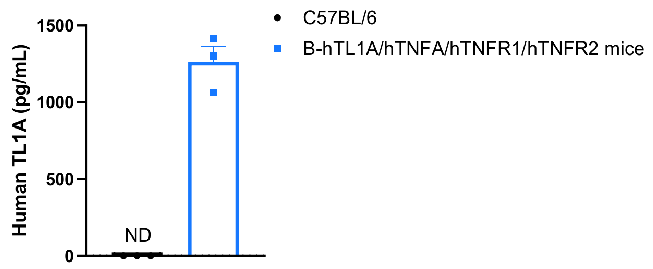
      Human TL1A Protein Expression Analysis in BMDCs Supernatants of TL1A/TNFA/TNFR1/TNFR2 Humanized Mice
      • Soluble human TL1A was exclusively detectable in homozygous TL1A/TNFA/TNFR1/TNFR2 humanized mice but not wild-type C57BL/6 mice.

      Soluble TL1A expression analysis in TL1A/TNFA/TNFR1/TNFR2 humanized mice by ELISA. Bone marrow derived dendritic cells (BMDCs) were produced by culturing the bone marrow from wild-type C57BL/6 mice (+/+) and homozygous B-hTL1A/hTNFA/hTNFR1/hTNFR2 mice (H/H;H/H;H/H;H/H), which were stimulated with LPS in vitro. After stimulation, the supernatants were collected and the levels of soluble TL1A were measured using the species-specific human TL1A ELISA kit. Soluble human TL1A was exclusively detectable in homozygous B-hTL1A/hTNFA/hTNFR1/hTNFR2 mice but not wild-type C57BL/6 mice. Values are expressed as mean ± SEM. ND: not detectable.
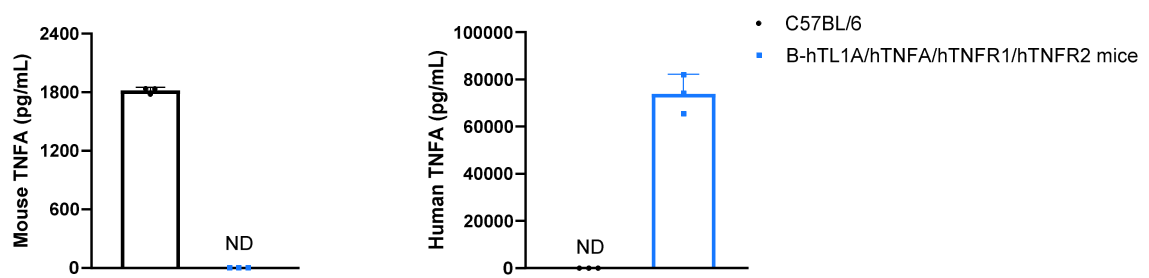
      Human TNFA Protein Expression Analysis in Serum of TL1A/TNFA/TNFR1/TNFR2 Humanized Mice
      • Mouse TNFA was only detectable in wild-type C57BL/6 mice, and human TNFA was only detectable in homozygous TL1A/TNFA/TNFR1/TNFR2 humanized mice. 

      Strain-specific TNFA expression analysis in wild-type C57BL/6 mice and homozygous TL1A/TNFA/TNFR1/TNFR2 humanized mice by ELISA. Serum were collected from wild-type C57BL/6 mice (+/+) and homozygous B-hTL1A/hTNFA/hTNFR1/hTNFR2 mice (H/H;H/H;H/H;H/H), the production of TNFA in serum were assessed after 1 h of stimulation with LPS in vivo. and analyzed by ELISA with species-specific mouse TNFA ELISA kit (Biolegend, 430907) and human TNFA ELISA kit (Biolegend, 430207). Mouse TNFA was detectable in wild-type C57BL/6 mice. Human TNFA was exclusively detectable in homozygous B-hTL1A/hTNFA/hTNFR1/hTNFR2 mice. Values are expressed as mean ± SEM. ND: not detectable.
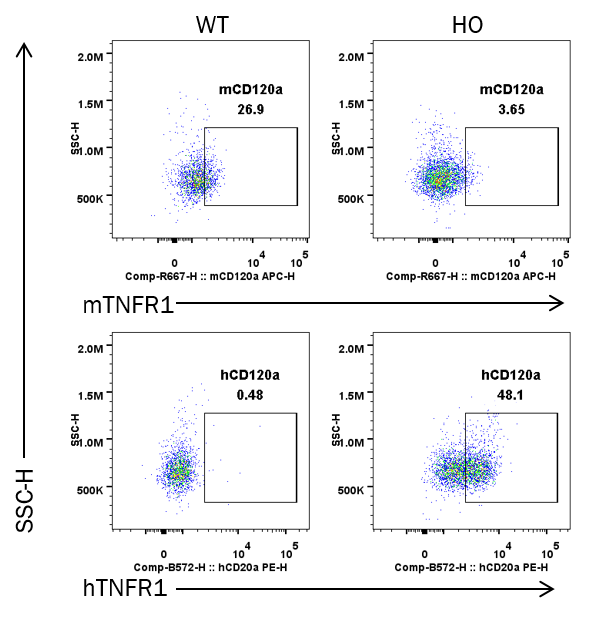
      Human TNFR1 Protein Expression Analysis in Spleen of TL1A/TNFA/TNFR1/TNFR2 Humanized Mice
      • Human TNFR1 was exclusively expressed on neutrophils of TL1A/TNFA/TNFR1/TNFR2 humanized mice.

      Strain-specific TNFR1 expression analysis in homozygous TL1A/TNFA/TNFR1/TNFR2 humanized mice by flow cytometry. Splenocytes were collected from wild-type C57BL/6 mice (+/+) and homozygous B-hTL1A/hTNFA/hTNFR1/hTNFR2 mice (H/H;H/H;H/H;H/H), and analyzed by flow cytometry with species-specific anti-CD120a/TNFR1 antibodies. Mouse TNFR1/CD120a was detectable on neutrophils of C57BL/6 mice. Human TNFR1/CD120a was exclusively detectable on neutrophils of homozygous B-hTL1A/hTNFA/hTNFR1/hTNFR2 mice but not in C57BL/6 mice. WT: C57BL/6 mice, HO: B-hTL1A/hTNFA/hTNFR1/hTNFR2 mice.
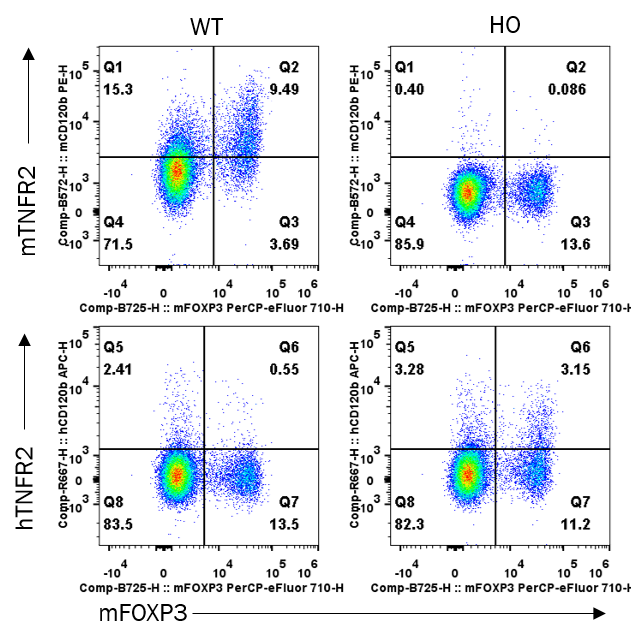
      Human TNFR2 Protein Expression Analysis in Spleen of TL1A/TNFA/TNFR1/TNFR2 Humanized Mice
      • Human TNFR2 was exclusively expressed on Treg cells of TL1A/TNFA/TNFR1/TNFR2 humanized mice.

      Strain-specific TNFR2 expression analysis in homozygous TL1A/TNFA/TNFR1/TNFR2 humanized mice by flow cytometry. Splenocytes were collected from wild-type C57BL/6 mice (+/+) and homozygous B-hTL1A/hTNFA/hTNFR1/hTNFR2 mice (H/H;H/H;H/H;H/H), and analyzed by flow cytometry with species-specific anti-TNFR2/CD120b antibodies. Mouse TNFR2/CD120b was detectable on Treg cells of C57BL/6 mice. Human TNFR2/CD120b was exclusively detectable on Treg cells of homozygous B-hTL1A/hTNFA/hTNFR1/hTNFR2 mice. WT: C57BL/6 mice, HO: B-hTL1A/hTNFA/hTNFR1/hTNFR2 mice.

      * When publishing results obtained using this animal model, please acknowledge the source as follows: The animal model [B-hTL1A/hTNFA/hTNFR1/hTNFR2 mice] (Cat# 113030) was purchased from Biocytogen.