Description
Targeting the TRBC1/TRBC2: Biological Roles and Therapeutic Strategies
- Gene Information: TRBC1, and TRBC2 encode the constant regions of the T-cell receptor (TCR) alpha and beta chains, where mutually exclusive TRBC1 or TRBC2 selection establishes a distinct genetic marker for clonal T-cell populations.
- Protein Expression: These proteins form the structural backbone of the surface αβTCR-CD3 complex, which is universally present on healthy T cells but exhibits strict monotypic restriction (either TRBC1 or TRBC2) on malignant T-cell clones.
- Signaling Pathway: Antigen engagement shifts the TCR constant domain to trigger downstream CD3 phosphorylation cascades, activating essential transcription factors for T-cell proliferation and survival.
- Therapeutic Inhibition: Targeting the specific TRBC subunit expressed by the lymphoma allows CAR-T cells or antibodies to selectively eradicate the malignancy while preserving the reciprocal, healthy T-cell compartment to maintain immunity.
Targeting the LAG3: Biological Roles and Therapeutic Strategies
- Gene Information: LAG3 is encoded by the LAG3 gene located on chromosome 12p13.31, sharing significant structural homology and evolutionary lineage with CD4.
- Protein Expression: The protein functions as a co-inhibitory immune checkpoint receptor selectively upregulated on activated T cells, regulatory T cells (Tregs), NK cells, and plasmacytoid dendritic cells.
- Signaling Pathway: High-affinity binding to ligands such as MHC class II, LSECtin, or FGL1 transmits negative signals through LAG3's intracellular KIEELE motif to arrest TCR signaling, block cell cycle progression, and drive T-cell exhaustion.
- Therapeutic Inhibition: Targeting LAG3 with blocking monoclonal antibodies or bispecific molecules reverses T-cell exhaustion, restores anti-tumor cytotoxicity, and synergizes with PD-1/PD-L1 inhibitors to overcome immune checkpoint resistance.
Targeting strategy
TRBC1/TRBC2
- The exon 1-2, partial exon 3 and intron 1-2 of mouse Trbc1 and Trbc2 were replaced by human exon 1-2, partial exon 3 and intron 1-2 of human TRBC1 and TRBC2 in B-hTRBC1/hTRBC2/hLAG3 plus mice.
LAG3
- The exons 2-7 of mouse Lag3 gene that encode extracellular domain are replaced by human counterparts in B-hTRBC1/hTRBC2/hLAG3 plus mice. The genomic region of mouse Lag3 gene that encodes transmembrane domain and cytoplasmic portion is retained. The promoter, 5’UTR and 3’UTR region of the mouse gene are also retained. The chimeric LAG3 expression is driven by endogenous mouse Lag3 promoter, while mouse Lag3 gene transcription and translation will be disrupted.
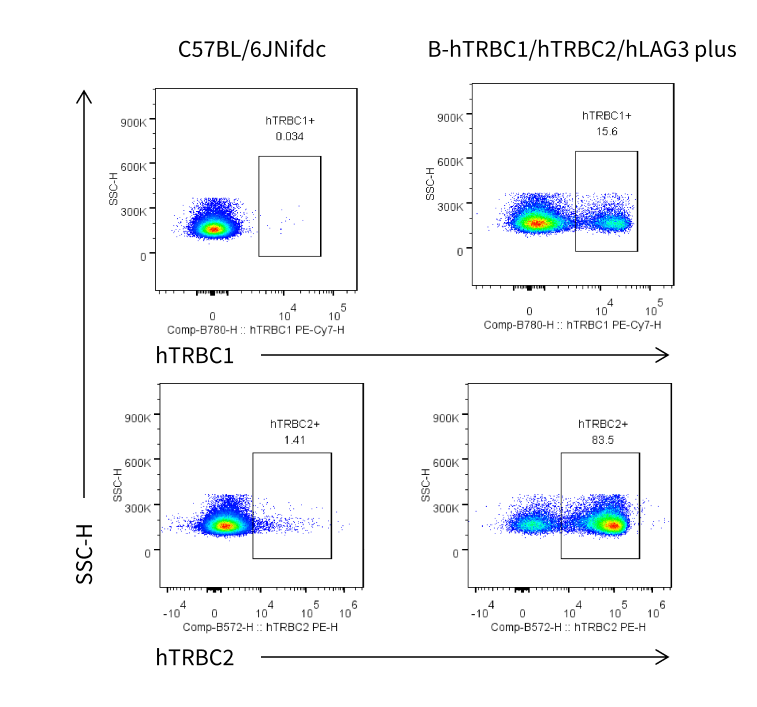
TRBC1 and TRBC2 Protein Expression Analysis
Strain specific TRBC1 and TRBC2 expression analysis in wild-type C57BL/6JNifdc mice and homozygous B-hTRBC1/hTRBC2/hLAG3 plus mice by flow cytometry. Splenocytes were collected from wild-type C57BL/6JNifdc mice (+/+) and homozygous B-hTRBC1/hTRBC2/hLAG3 plus mice (H/H), and analyzed by flow cytometry with species-specific anti-human TRBC1 antibody (Biolegend, 383502) and anti-human TRBC2 antibody (BD, 571190).
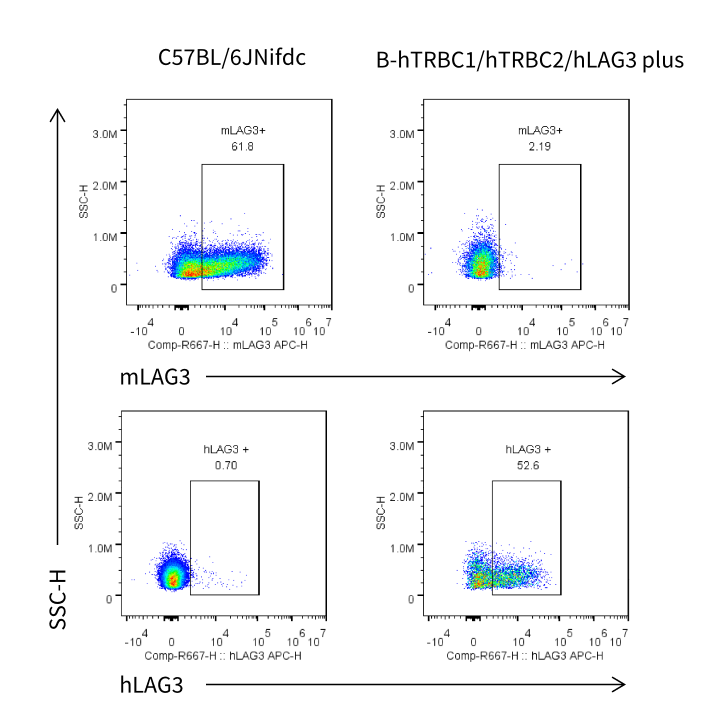
LAG3 Protein Expression Analysis
Strain specific LAG3 expression analysis in homozygous B-hTRBC1/hTRBC2/hLAG3 plus mice by flow cytometry. Splenocytes were collected from wild-type C57BL/6JNifdc (+/+) and homozygous B-hTRBC1/hTRBC2/hLAG3 plus mice (H/H) after stimulated with anti-mouse CD3ε antibody (7.5 μg, i.p.) in vivo for 24 hrs (male, 8-week-old), and analyzed by flow cytometry with anti-mouse LAG3 antibody (Biolegend, 125242) and anti-human LAG3 antibody (Biolegend, 369212).
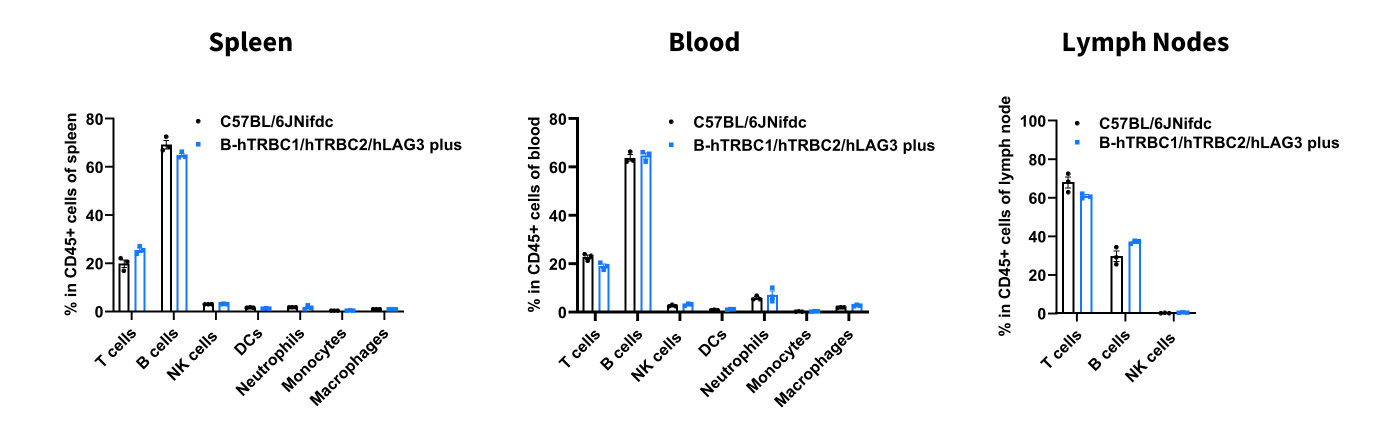
Analysis of Leukocyte Subpopulations of B-hTRBC1/hTRBC2/hLAG3 plus mice
Analysis of leukocyte subpopulations by flow cytometry in immune organs and blood. Splenocytes, peripheral blood, and lymph nodes were isolated from female C57BL/6JNifdc mice and B-hTRBC1/hTRBC2/hLAG3 plus mice (male, 10-week-old, n = 3). Single live cells were gated on the CD3⁺ T-cell population and analyzed by flow cytometry as indicated. Values are expressed as mean ± SEM.
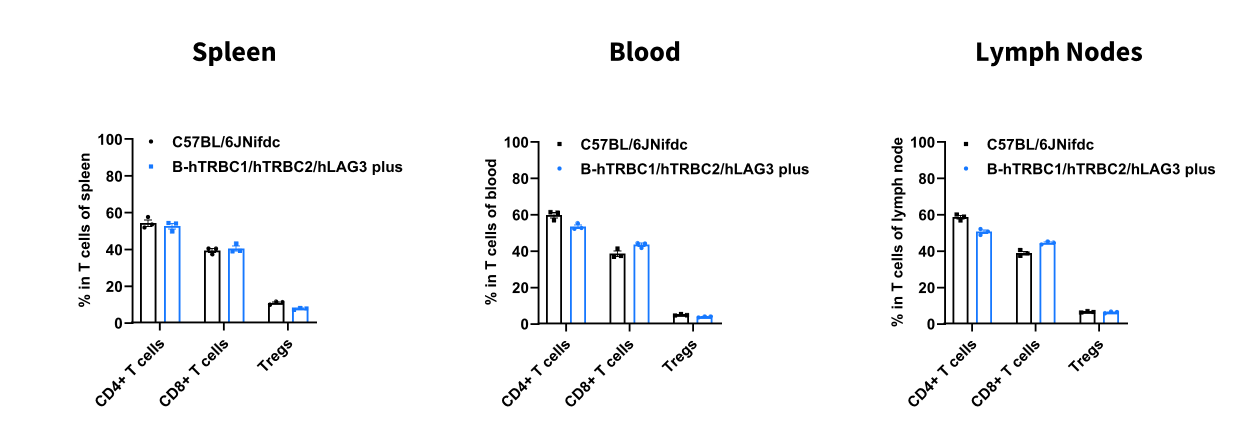
Analysis of T Cell Subpopulations of B-hTRBC1/hTRBC2/hLAG3 plus mice
Analysis of T-cell subpopulations by flow cytometry in immune organs and blood. Splenocytes, peripheral blood, and lymph nodes were isolated from female C57BL/6JNifdc and B-hTRBC1/hTRBC2/hLAG3 plus mice (male, 10-week-old, n = 3). Single live cells were gated on the CD3⁺ T-cell population and analyzed by flow cytometry as indicated. Values are expressed as mean ± SEM.
* When publishing results obtained using this animal model, please acknowledge the source as follows: The animal model [B-hTRBC1/hTRBC2/hLAG3 plus mice] (Cat# 114259) was purchased from Biocytogen.